Isaac 1

Height

3 ft to 5 ft 9 in

Battery

8 h

Home Assistants Pre-order

Isaac 1

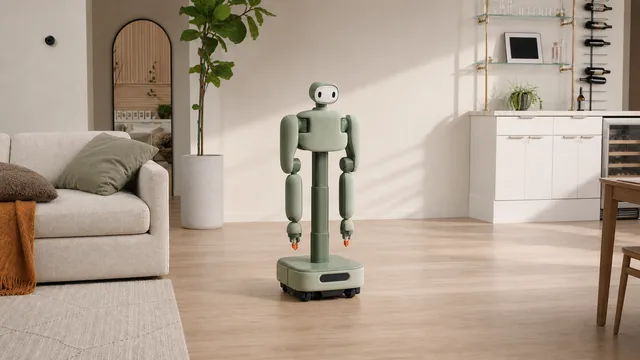
Isaac 1 is Weave Robotics' wheeled mobile home robot for laundry and room reset tasks. Official materials describe Laundry Flow for finding and picking up dirty clothes, handling loaded hampers, folding, and putting clothes away, plus Daily Reset for making beds, fixing pillows and blankets, and returning toys, shoes, and clutter to their places. Weave says Isaac 1 navigates and completes these tasks autonomously by default, with teleoperation assistance when needed, and is controlled through a companion app for on-demand or scheduled work. The company lists an 8-hour battery, 2-hour charge time, Wi-Fi, a 20.5 x 22 inch footprint, a 3 ft to 5 ft 9 in height range, and first California shipments in fall 2026.
Listed price

$7,999

$7,999 up-front or $449/month subscription; optional $99/month premium membership for up-front customers. Official pre-order page requires a fully refundable $250 deposit, with California deliveries beginning in fall 2026 and broader U.S. availability starting in 2027.

Release window

Jul 1, 2026

Current status

Pre-order

Weave Robotics

Last verified

Jul 3, 2026

Share this robot

Open a plain share composer on X or Bluesky for this robot profile.

Technical overview

Core specifications and system stack

A fast read on the mechanical profile, sensing package, and listed platform details for Isaac 1.

Technical Specifications

Height

3 ft to 5 ft 9 in

Weight

Not officially disclosed

Dimensions

20.5 x 22 in footprint; 80 in vertical reach; 38 in horizontal reach

Battery Life

8 h

Charging Time

2 h

Max Speed

Not officially disclosed

Tech Components

Connectivity (1)

Operational profile

How this robot is configured

Capabilities

15

Connectivity

1

Key capabilities

Mobile home task robotLaundry Flow for finding and picking up dirty clothesLoaded hamper handlingLaundry folding and put-awayDaily Reset room tidyingBed makingPillow and blanket fixingToy, shoe, and clutter return

Listed platforms & ecosystem

Weave companion app

About the Isaac 1

1Protocol15CapabilitiesUSD $7,999Listed Price

The Isaac 1 is a Home Assistants robot built by Weave Robotics. Isaac 1 is Weave Robotics' wheeled mobile home robot for laundry and room reset tasks. Official materials describe Laundry Flow for finding and picking up dirty clothes, handling loaded hampers, folding, and putting clothes away, plus Daily Reset for making beds, fixing pillows and blankets, and returning toys, shoes, and clutter to their places. Weave says Isaac 1 navigates and completes these tasks autonomously by default, with teleoperation assistance when needed, and is controlled through a companion app for on-demand or scheduled work. The company lists an 8-hour battery, 2-hour charge time, Wi-Fi, a 20.5 x 22 inch footprint, a 3 ft to 5 ft 9 in height range, and first California shipments in fall 2026.

The Isaac 1 is listed at USD $7,999. $7,999 up-front or $449/month subscription; optional $99/month premium membership for up-front customers. Official pre-order page requires a fully refundable $250 deposit, with California deliveries beginning in fall 2026 and broader U.S. availability starting in 2027. See all Weave Robotics robots on the Weave Robotics page.

Spec Breakdown

Detailed specifications for the Isaac 1

Height

3 ft to 5 ft 9 in

The listed height is 3 ft to 5 ft 9 in. Height alone does not establish working reach or clearance under furniture; check the documented operating configuration and required space.

Dimensions

20.5 x 22 in footprint; 80 in vertical reach; 38 in horizontal reach

The overall dimensions of 20.5 x 22 in footprint; 80 in vertical reach; 38 in horizontal reach are a recorded size entry. Check which axes and configuration it covers: a height-only entry does not establish width, depth or passage fit. Planning clearance also requires the operating envelope, turning space, attachments and documented margins.

Battery Life

8 hours

This is the recorded runtime entry. Test conditions and independent verification are not established by this field. Confirm workload, operating mode and environmental conditions before comparing runtimes.

Charging Time

2 hours

A charging time of 2 hours means the ratio of operation to downtime is an important consideration for applications requiring near-continuous availability. Some deployments use multiple robots in rotation to maintain uninterrupted service.

Read this recorded AI entry alongside the model description and source notes for announcement or deployment context. A platform name alone does not establish implemented features, autonomy, or performance.

Isaac 1 Sensor Suite

Sensor details are not specified in the available profile. This does not establish that sensors are absent.

Consult the linked profile sources for hardware configuration and tested behavior. A technology label alone does not verify an operating capability.

Explore sensor technologies: components glossary · full components directory

Isaac 1 Use Cases & Applications

Home assistant robots combine the functionality of a smart speaker, tablet, security camera, and telepresence device into a mobile platform that follows you or patrols your home. They represent the next evolution of smart home interaction.

Recorded Capabilities

The Isaac 1 record lists 15 capabilities. Keep any announcement or demonstration qualifiers attached to these entries; the count alone does not establish practical performance.

Mobile home task robot
Laundry Flow for finding and picking up dirty clothes
Loaded hamper handling
Laundry folding and put-away
Daily Reset room tidying
Bed making
Pillow and blanket fixing
Toy, shoe, and clutter return
Autonomous home navigation and task execution
Teleoperation assistance when needed
On-demand and scheduled app control
Collapsible torso
Swappable or removable soft shells
Wheeled passively stable base
21 listed degrees of freedom across neck, arms, hands, torso, and base

These are the capabilities listed in the profile. Hardware configuration and demonstrated performance should be checked against the linked sources.

Listed Platforms & Ecosystem

These are the platforms, communities, or ecosystem relationships listed in the profile. A listed name or protocol alone does not confirm home-device interoperability or automation support.

Weave companion app

Isaac 1 Capabilities

15

Capabilities

AI

Autonomous Laundry Flow and…

Mobile home task robot
Laundry Flow for finding and picking up dirty clothes
Loaded hamper handling
Laundry folding and put-away
Daily Reset room tidying
Bed making
Pillow and blanket fixing
Toy, shoe, and clutter return
Autonomous home navigation and task execution
Teleoperation assistance when needed
On-demand and scheduled app control
Collapsible torso
Swappable or removable soft shells
Wheeled passively stable base
21 listed degrees of freedom across neck, arms, hands, torso, and base

Listed Connectivity & Voice Systems

The Isaac 1 profile lists the following communication and voice-system descriptions.

Network & Communication Details

Listed network interfaces do not by themselves identify supported services, integrations, or device-control functions.

Who Should Consider the Isaac 1?

Target Audience

Home assistant robots target households looking for a mobile smart home hub that can move between rooms, provide video communication, monitor the home, and assist with daily tasks. Early adopters and smart home enthusiasts are the primary market.

Key Considerations

Mobility range, smart home platform integration, camera quality for video calls and monitoring, microphone/speaker quality for voice interaction, and the breadth of assistive capabilities are key. Consider privacy features (physical camera shutters, mute buttons) and whether the robot can navigate your home layout reliably.

Listed pricing

The Isaac 1 is listed at USD $7,999. $7,999 up-front or $449/month subscription; optional $99/month premium membership for up-front customers. Official pre-order page requires a fully refundable $250 deposit, with California deliveries beginning in fall 2026 and broader U.S. availability starting in 2027.

Availability

Pre-order

The Isaac 1 is listed for pre-order, indicating a reservation listing. The label alone does not establish engineering completion or guarantee a delivery queue position. Check Weave Robotics's reservation terms, regional availability, and estimated delivery dates.

Isaac 1: Strengths & Trade-offs

Recorded features and considerations to assess

Recorded features to assess for the Isaac 1

Recorded capability range

The Isaac 1 record lists 15 capabilities. Review their qualifiers and supporting evidence for the tasks you need. The number of entries does not establish workflow coverage, reliability, or the ability to replace other robots.

Recorded battery life

The battery-life entry is 8 hours. Check the source conditions and operating mode before using this figure to plan a session. It does not establish task completion, area coverage, or continuous-use runtime.

What to consider carefully

Listed Pre-order

The Isaac 1 is listed for pre-order, indicating a reservation listing. The label alone does not establish engineering completion or guarantee a delivery queue position. Check Weave Robotics's reservation terms, regional availability, and estimated delivery dates.

Note: This strengths and trade-offs assessment is based on the Isaac 1's documented specifications as tracked in the ui44 database. Real-world performance depends on deployment conditions, firmware maturity, and environmental factors. For the most current information, check the Weave Robotics manufacturer page or visit the official source. Use the comparison tool to evaluate these trade-offs against competing robots in the same category.

How Home Assistants Robot Technology Works

Understanding the engineering behind this category

Home assistant robots combine mobility, intelligence, and physical manipulation to perform tasks that stationary smart devices simply cannot. While a smart speaker can tell you the weather, a home assistant robot can bring you an umbrella. This emerging category represents the convergence of multiple robotic technologies — navigation, manipulation, AI, and human-robot interaction — into a single household platform.

Navigation & Mobility

Home assistant robots must navigate the complex, cluttered, and constantly changing environment of a lived-in home. They use LiDAR, cameras, and depth sensors to build and continuously update maps of the home interior, handling furniture rearrangements, opened or closed doors, and transient obstacles like shoes and toys. Path planning must account for the robot's size (including any carried objects), doorway widths, carpet transitions, and areas where humans are present. Advanced systems create semantic maps that understand room functions — knowing the kitchen from the bedroom enables context-appropriate behavior like adjusting movement speed or interaction style.

The Role of AI

AI in home assistant robots must bridge the gap between high-level human instructions and low-level physical actions. When asked to bring a glass of water, the robot must understand the request, plan the task sequence (navigate to kitchen, find a glass, operate the tap, carry without spilling), and execute each step while handling unexpected situations. Foundation models and vision-language models are increasingly central to this task comprehension capability. The AI must also maintain context across interactions — remembering where items are usually kept, learning household routines, and anticipating needs based on time of day and activity patterns.

Sensor Fusion & Perception

Home assistant robots require comprehensive perception that combines environmental mapping with object-level understanding. Cameras and depth sensors identify objects and their positions. Force sensors in hands and arms enable safe grasping and manipulation without crushing or dropping items. Proximity sensors prevent collisions during navigation, especially when carrying objects that extend the robot's footprint. Audio processing detects and localizes voice commands from anywhere in the home. Some robots include sensors for detecting spills, open doors, or unusual sounds that might indicate a problem requiring attention.

Power & Battery Management

Home assistant robots face challenging power requirements due to the combination of mobility, computation, and manipulation. Battery technology limits operational time to several hours before recharging is needed. Smart power management prioritizes tasks by urgency and groups actions by location to minimize unnecessary movement. Autonomous docking and charging ensure availability when needed. Some designs use lighter-weight arms and efficient actuators to reduce power consumption during manipulation tasks. The ability to plan efficient routes through the home — minimizing backtracking and unnecessary movement — directly impacts how much useful work the robot can accomplish per charge cycle.

Safety by Design

Operating a robot with arms and hands in a home with people requires extensive safety engineering. Force-limiting actuators prevent the robot from exerting dangerous grip or impact forces. Speed reduction in the presence of detected humans protects against collision injuries. Object-drop prevention systems ensure the robot does not release carried items unexpectedly. Hot-liquid and sharp-object handling requires specialized grip and stability control. Emergency stop mechanisms allow any household member to immediately halt the robot. The system must fail safely — if power is lost while carrying an object, the gripper should default to a secure hold rather than releasing.

What's Next for Home Assistants Robots

Home assistant robots are at an early but rapidly advancing stage. The convergence of foundation models (for understanding tasks), improved dexterous manipulation (for executing them), and decreasing hardware costs (for making them accessible) is accelerating development. Near-term advances will likely focus on specific task competency — robots that excel at a few useful tasks rather than attempting to do everything. As these capabilities mature and costs decrease, the scope of home assistant robots will gradually expand toward the vision of a truly general-purpose household helper.

These are category-level technology examples; they do not establish the capabilities of the Isaac 1. For its recorded hardware details, see the sensor analysis and connectivity sections above. Check model-specific documentation from Weave Robotics for supported behavior, or use the components glossary to look up terminology.

Isaac 1 in the Home Assistants Market

How this robot compares in the home assistants landscape

The Isaac 1 is listed at USD $7,999. $7,999 up-front or $449/month subscription; optional $99/month premium membership for up-front customers. Official pre-order page requires a fully refundable $250 deposit, with California deliveries beginning in fall 2026 and broader U.S. availability starting in 2027.

The Isaac 1 is listed for pre-order, indicating a reservation listing. The label alone does not establish engineering completion or guarantee a delivery queue position. Check Weave Robotics's reservation terms, regional availability, and estimated delivery dates.

Head-to-Head Comparisons

Side-by-side specs, capability overlap analysis, and key differentiators.

For the full picture of Weave Robotics's portfolio and market strategy, visit the Weave Robotics manufacturer page.

Deployment Readiness and Procurement Signals for Isaac 1

What the public profile tells you, and what still needs direct vendor confirmation

From a buying and rollout perspective, the Isaac 1 should be read as a home assistants platform aimed at connected homes that want a mobile smart-home touchpoint. ui44 currently tracks 15 capability signals and a last verification date of 2026-07-03. That mix gives buyers a useful first-pass picture, but it is still only the public layer of due diligence, especially when procurement, uptime, and support commitments are decided directly with Weave Robotics.

Commercial model

USD $7,999 list price

The Isaac 1 is listed at USD $7,999. $7,999 up-front or $449/month subscription; optional $99/month premium membership for up-front customers. Official pre-order page requires a fully refundable $250 deposit, with California deliveries beginning in fall 2026 and broader U.S. availability starting in 2027.

Integration posture

1 connectivity option

The profile lists Wi-Fi. These labels do not establish APIs, fleet-management features, or workflow integration. These are the platforms, communities, or ecosystem relationships listed in the profile. A listed name or protocol alone does not confirm home-device interoperability or automation support.Recorded AI description: Autonomous Laundry Flow and Daily Reset by default, with teleoperation assistance when needed and over-the-air capability updates.

Spec disclosure

4/7 core specs public

ui44 currently has 4 of 7 core physical and operating specs filled in for this model, leaving 3 gaps that matter for deployment planning. Missing runtime, charge, speed, or payload details can materially change staffing and site-readiness assumptions.

The current profile is useful for scouting, but it still leaves meaningful operational unknowns. If this robot is heading toward a pilot or purchase discussion, the next step should be a structured vendor Q&A that fills the remaining runtime, charging, payload, safety, or integration blanks before anyone builds ROI assumptions around it.

If you want a faster apples-to-apples read, compare the Isaac 1 against nearby alternatives in ui44's compare view, then cross-check the underlying AI, sensor, and subsystem terms in the components glossary. For manufacturer-level context, the Weave Robotics profile helps anchor this robot inside the wider product lineup.

Before you sign off on a pilot, confirm these points

  • Verify travel speed and cycle time if the robot must keep up with people, lines, or service windows.
  • Clarify usable payload or tool-load limits before planning material handling or mounted accessories.
  • Check what safety, electrical, or deployment certifications exist for the region and task you care about.

Owning the Isaac 1: Setup, Maintenance & Tips

Practical guide from day one through years of ownership

Initial Setup

Home assistant robot setup involves physical placement, network configuration, environment mapping, and capability training. Place the charging dock in an accessible central location. Connect to your home Wi-Fi and smart home platform. Run the initial mapping session with all doors open and the home in its typical state. After mapping, configure room names, restricted areas, and any smart home integrations. For robots with manipulation capabilities, the setup may include teaching specific tasks by demonstration or configuring task parameters through the app. Expect to invest several sessions over the first week refining the robot's understanding of your home and preferences.

Ongoing Maintenance

Home assistant robots combine the maintenance needs of mobile platforms with those of manipulation systems. Weekly tasks include cleaning sensors, checking wheels and arm joints for debris, and verifying gripper functionality. Monthly maintenance should cover thorough sensor cleaning, software updates, and calibration checks. If the robot handles food or liquids, clean any contact surfaces after each use according to the manufacturer's hygiene guidelines. Monitor battery performance over time and report any significant degradation to the manufacturer.

Software Updates & Long-Term Support

Home assistant robot software updates are particularly impactful because they can add entirely new task capabilities. A robot that launches with five core tasks might gain additional abilities through software updates as the manufacturer develops and validates new skills. Keep automatic updates enabled and review update notes to discover new capabilities you might not have known were added. Major platform updates may also improve task execution quality for existing capabilities — making the robot more reliable and efficient at tasks it could already perform.

Maximizing Longevity

Home assistant robots represent a significant investment, and proper care maximizes that investment's return. Avoid exceeding payload limits when the robot carries objects. Keep the operating environment reasonably tidy to reduce navigation challenges. Maintain clean, unobstructed sensor surfaces for reliable operation. For robots with arms, avoid forcing joints beyond their range of motion. Address any unusual sounds or behaviors promptly — early intervention prevents small issues from becoming expensive repairs. Consider a manufacturer service plan for access to priority support and replacement parts.

Find product and source links on the Weave Robotics page on ui44 or open Weave Robotics's official source. Use model-specific manufacturer documentation for setup, cleaning, and service instructions.

Frequently Asked Questions

What is the Isaac 1?
The Isaac 1 is a Home Assistants robot made by Weave Robotics. Isaac 1 is Weave Robotics' wheeled mobile home robot for laundry and room reset tasks. Official materials describe Laundry Flow for finding and picking up dirty clothes, handling loaded hampers, folding, and putting clothes away, plus Daily Reset for making beds, fixing pillows and blankets, and returning toys, shoes, and clutter to their places. Weave says Isaac 1 navigates and completes these tasks autonomously by default, with teleoperation assistance when needed, and is controlled through a companion app for on-demand or scheduled work. The company lists an 8-hour battery, 2-hour charge time, Wi-Fi, a 20.5 x 22 inch footprint, a 3 ft to 5 ft 9 in height range, and first California shipments in fall 2026.
How much does the Isaac 1 cost?
The Isaac 1 is listed at USD $7,999. $7,999 up-front or $449/month subscription; optional $99/month premium membership for up-front customers. Official pre-order page requires a fully refundable $250 deposit, with California deliveries beginning in fall 2026 and broader U.S. availability starting in 2027.
Is the Isaac 1 available to buy?
The Isaac 1 is listed for pre-order, indicating a reservation listing. The label alone does not establish engineering completion or guarantee a delivery queue position. Check Weave Robotics's reservation terms, regional availability, and estimated delivery dates.
What sensors are reported for the Isaac 1?
Sensor details are not specified in the available profile. This does not establish that sensors are absent. See the sensor information section for details.
How long does the Isaac 1 battery last?
Test conditions and independent verification are not established by these fields. Confirm workload, operating mode and environmental conditions before comparing runtimes. Recorded runtime: 8 hours Recorded charging entry: 2 hours
What AI does the Isaac 1 use?
How does the Isaac 1 compare to the W1?
The Isaac 1 and W1 are both home assistants robots, but they differ in key specifications, pricing, and manufacturer approach. Use the side-by-side comparison tool to see detailed differences in specs, sensors, and capabilities. You can also browse other similar robots.
What platforms or ecosystem relationships are listed for the Isaac 1?
These are the platforms, communities, or ecosystem relationships listed in the profile. A listed name or protocol alone does not confirm home-device interoperability or automation support. Weave companion app
How current is the Isaac 1 data on ui44?
The Isaac 1 record has a last-checked date of 2026-07-03. Consult the model description, source links, and attribution notes for the basis of individual claims. This date does not mean every claim is manufacturer-confirmed or independently tested. If you notice outdated information, please let us know.

Data Integrity

The Isaac 1 record brings together the listed specifications and attributed claims. Consult the model description and source notes to distinguish manufacturer announcements, reported information, and unknowns. A source link or review date does not establish independent testing or manufacturer confirmation of every claim. Record last checked: 2026-07-03. Official source: Weave Robotics official source. If you find outdated or incorrect information, please let us know — accuracy is our top priority.

Explore More on ui44

Explore more home assistants robots

See how the Isaac 1 stacks up — compare specs, browse the home assistants category, or search the full database.